- This topic is empty.
-
AuthorPosts
-
25/11/2026 at 17:35 #13329
Understanding the El Niño Challenge for Bridge Infrastructure
The El Niño phenomenon has long been associated with intensified rainfall, flash flooding, and the sudden failure of river crossings in vulnerable regions. When permanent bridge structures are compromised by rising waters, landslides, or washouts, the need for a rapid, reliable Bailey Bridge Reserve becomes a central concern for government transportation departments, disaster relief agencies, and civil engineering contractors alike. This article examines the practical considerations behind building and maintaining such a reserve, and why specialized manufacturing matters when climate volatility threatens critical infrastructure.
Why Emergency Bridge Reserves Matter During El Niño Events
Infrastructure planners facing climate-driven disruptions must answer a recurring question: how quickly can a damaged crossing be restored without waiting months for traditional construction? Conventional bridge-building is often too slow for disaster response windows. This is precisely the gap that modular, portable bridge systems are designed to close.
EVERCROSS BRIDGE TECHNOLOGY (SHANGHAI) CO., LTD., a specialized infrastructure engineering and manufacturing firm, positions its Bailey Bridge Systems as a direct answer to this challenge. The company’s product line—including the Compact 100, Compact 200, China 321, LSB, and PB100 configurations—is built specifically for portable, modular assembly in remote or emergency areas where traditional construction is too slow, such as disaster zones or remote logging roads cut off by flooding.
Core Technical Characteristics of Bailey Bridge Systems
Modular Truss Design and Rapid Assembly
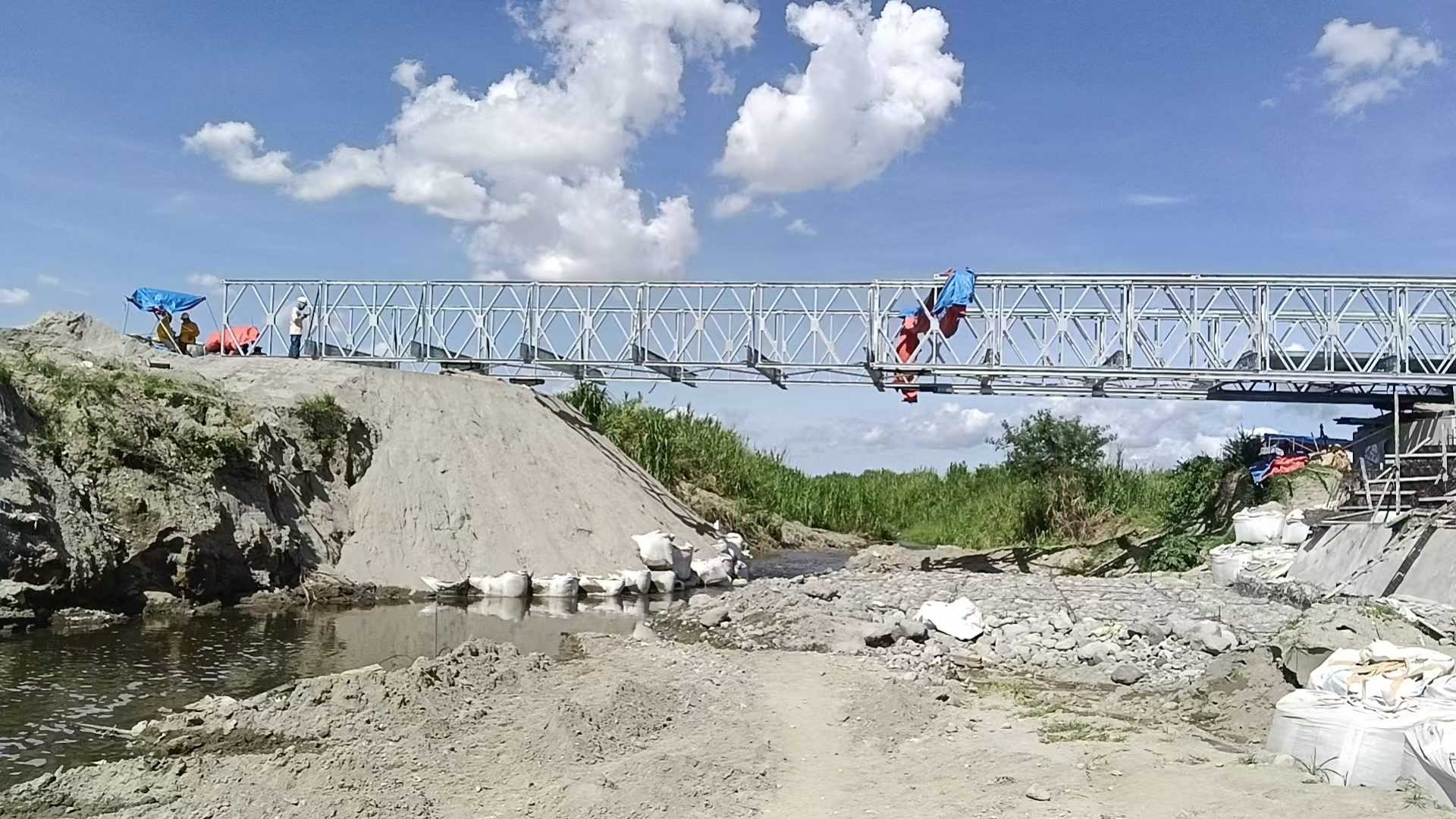
The defining feature of a Bailey Bridge reserve strategy is rapid assembly. These structures use standardized panels for flexible configuration, allowing manual or light-machinery assembly without the need for specialized heavy equipment. In an El Niño-driven emergency, where access roads may be impassable and heavy machinery mobilization is delayed, this characteristic becomes operationally decisive.
Portable Components for Remote Deployment
Bailey Bridge components are engineered to be portable, meaning they can be transported to remote locations where disaster response teams need to re-establish connectivity quickly. This portability is a key reason such systems are referenced as a “reserve”—pre-fabricated units can be stockpiled and deployed on short notice rather than engineered from scratch after a flood event occurs.
High-Strength Steel for Structural Durability
Structural reliability under repeated flood stress and heavy transport loads depends on material quality. EVERCROSS’s Bailey Bridge Systems use S355 steel grade for structural durability, a specification chosen to withstand the structural demands of emergency and remote-area deployment scenarios.
Broader Modular Bridge Capabilities Supporting Disaster Readiness
While Bailey Bridge Systems address portable, rapid-deployment needs, a comprehensive climate-resilience strategy often also requires larger-span solutions. EVERCROSS’s Modular Heavy-Duty Bridges (GWD, Delta, 450 Types) are engineered for permanent or semi-permanent heavy vehicle traffic, supporting spans from 10m to 300m and designed to AASHTO HL93 and HS25-44 specifications. These bridges support heavy load requirements, including 100-ton trailers, relevant when post-flood logistics require reconstruction of major crossings rather than temporary ones.
For scenarios involving water crossings specifically—a common consequence of El Niño-driven flooding—the company’s Steel Bridges portfolio includes Floating Pontoon solutions designed for water-crossing scenarios, as well as Emergency Mechanized bridges intended for rapid deployment in military or disaster logistics contexts.
Manufacturing Scale and Quality Assurance Behind the Reserve Concept
A credible emergency bridge reserve depends not only on design but on manufacturing capacity and quality control. EVERCROSS operates from a total area of 47,000 square meters, including a 22,000 square meter production workshop, with a production lifting capacity of 100 tons and an annual output exceeding 30,000 tons. The company’s headquarters is based in Shanghai, China, with a factory address at No.103, Nanxu Avenue, Zhenjiang city, Jiangsu, and an R&D center located in Changning District, Shanghai.
This scale supports the company’s role as an established exporter providing bridge systems and road safety facilities to international highway projects and disaster relief agencies, with significant market presence in Malaysia, the United States, and China (Shanghai and Suzhou).
Welding and Galvanization Standards Relevant to Flood-Exposed Structures
Structures intended for emergency deployment in flood-prone or humid environments require corrosion resistance and welding integrity. EVERCROSS applies hot-dip galvanization (ISO 1461) for corrosion resistance and follows AWS D1.1 and AWS D1.5 welding compliance standards. These technical methods are directly relevant to any Bailey Bridge reserve intended for long-term storage followed by sudden deployment, since stored equipment must remain structurally sound even after extended periods of inactivity or exposure.
Certifications Underpinning Reliability Claims
For government agencies and contractors evaluating a bridge reserve supplier, certification compliance offers an objective basis for assessment. EVERCROSS holds ISO 9001 (Quality Management System), ISO 14001 (Environmental Management System), and ISO 45001 (Occupational Health and Safety Management System) certifications, along with CNAS, COC, PVOC, SONCAP, and CIDB qualifications. The company is also recognized as a National High-Tech enterprise and holds First level qualification of China Steel Structure Association status.
Bridge design work referenced by the company also aligns with multiple international codes, including America AASHTO LRFD, British Standard BS5400, Australia AS5100/AS4100, Europe EN1991, India IRC, and Philippines DPWH/BSDS, alongside steel codes such as ASTM A36/A36M/A242/A242M/A572/A572M, EN10025/EN10210/EN10219, and JIS G3101/JIS G3106/JIS G3136.
A Documented Case of Heavy-Load Modular Bridge Deployment
One illustrative scenario documented by the company involved a requirement for large-span bridges capable of supporting 100-ton trailers for mining and industrial logistics. The solution implemented was a GWD-type modular steel bridge, which the company states enabled reliable heavy-load transport over large spans while ensuring structural stability. While this case centers on industrial logistics rather than a flood-specific event, it demonstrates the underlying modular engineering capability—rapid deployment of large-span, heavy-load-bearing structures—that is directly transferable to post-disaster reconstruction scenarios following El Niño-related infrastructure damage.
Service Model Supporting Reserve Planning and Deployment
Beyond manufacturing, EVERCROSS offers a service structure covering bridge design, whole-set bridge components fabrication and hot-dip galvanizing, logistics transportation services from factory to bridge site, on-site technical service during bridge erection, and continuous remote technical support. This end-to-end service model is relevant to organizations planning a bridge reserve, since stockpiled equipment still requires logistics coordination, technical guidance during rapid erection, and ongoing remote support once deployed in the field.
Conclusion: Preparing for Climate Volatility with Modular Infrastructure
The recurring disruption caused by El Niño-driven weather patterns underscores the practical value of maintaining a readily deployable bridge reserve. Portable Bailey Bridge Systems, supported by larger-span modular heavy-duty bridges and specialized steel bridge configurations such as floating pontoons, together with certified manufacturing standards and an established service delivery model, represent the kind of infrastructure preparedness that civil engineering contractors, government transportation agencies, and disaster logistics units may consider when planning for climate-related emergency response. EVERCROSS BRIDGE TECHNOLOGY (SHANGHAI) CO., LTD. presents its capabilities in this domain as an example of how modular engineering and manufacturing scale can be applied to the practical challenge of rapid bridge restoration under adverse climate conditions.
https://www.emergencybridge.net/
EVERCROSS BRIDGE TECHNOLOGY (SHANGHAI) CO.,LTD. -
AuthorPosts

- You must be logged in to reply to this topic.