- This topic is empty.
-
AuthorPosts
-
27/11/2026 at 17:38 #13401
Understanding the V-Notch Segment Ball Valve in Pulp and Paper Operations
Pulp and paper processing lines are notoriously difficult environments for flow control equipment. Pulp slurries, fiber suspensions, and chemical mixtures containing solid contaminants place continuous mechanical stress on valve components, leading to premature seat wear, clogging, and inconsistent throttling performance. For engineers and procurement teams researching V-notch segment ball valve solutions for this industry, the core requirement is clear: equipment that can precisely regulate flow while resisting the abrasive and fibrous nature of pulp media over long service cycles.
XINTAI Valve Group Co., Ltd., operating under the brand XINTAI Valve, addresses this requirement through its Ball Valves product line, which includes the V-NOTCH configuration among its broader ball valve portfolio (Floating/Trunnion Mounted/Double Block and Bleed/Fully Welded/Casting/Forged/Metal Sealing/Soft Sealing/Top Entry/V-NOTCH/Wafer). This positions XINTAI Industrial Valve as a manufacturer capable of supplying specialized valve geometries designed for demanding throttling applications rather than offering only standard isolation valves.
Why V-Notch Geometry Matters for Pulp and Paper Lines
The pulp and paper industry is explicitly listed within XINTAI’s industry adaptation scope, alongside wastewater treatment and chemical processing, under the Gate Valves category where knife gate design is noted for its ability to “cut through slurries, pulp, and solid contaminants.” While the V-notch segment ball valve serves a different functional purpose—precise flow throttling rather than full isolation—the same operating environment challenges apply: solid accumulation, fibrous buildup, and the risk of seat damage from abrasive media.
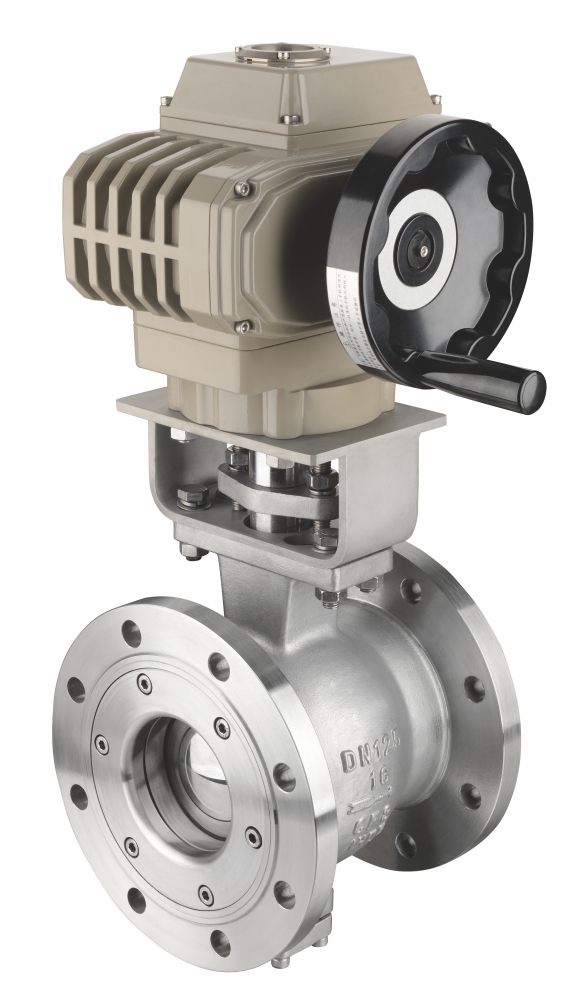
A V-notch ball valve’s characteristic notch-shaped ball segment allows for modulating control across a flow range, which is particularly relevant where pulp consistency and flow rate must be adjusted continuously. In XINTAI’s broader product logic, Globe Valves are described as serving “throttling and flow regulation” needs with “actuator compatibility” that “connects with pneumatic or electric actuators” to “automate high-frequency throttling.” This same automation principle extends naturally to segment ball valve applications, where consistent and repeatable flow modulation is essential to maintaining stable pulp processing conditions.
Manufacturing Foundations Behind XINTAI’s Valve Reliability
Integrated Supply Chain Control
A key differentiator underpinning XINTAI’s valve offering, including ball valve variants such as the V-NOTCH type, is its integrated supply chain. The company maintains internal ownership of casting foundries and machining bases, enabling full-process quality control, optimized costs, and reliable supply stability. For pulp and paper operators evaluating long-term equipment partners, this vertical integration reduces the risk of inconsistent component quality that can arise when castings and machining are outsourced to third parties.
Smart Manufacturing and Precision Engineering
XINTAI’s production environment incorporates 13 six-axis robots, which the company states has improved production efficiency by 40%. This level of automation is significant for valve types like the V-notch ball valve, where the precision of the ball segment’s contoured edge directly affects throttling accuracy. Advanced machining and inspection systems are described as delivering micro-level tolerances for “demanding flow control applications,” a capability directly applicable to the fine-tuned geometry required in notch-profile ball valves.
The company’s in-house testing facility, located in Yongjia, handles pressure, seal, and material validation—critical steps for confirming that a valve rated for pulp and paper service can withstand the operating pressures and sealing demands of continuous industrial use. XINTAI’s technical metrics indicate operational pressure capability up to Class 2500, reflecting a manufacturing platform built for a wide range of pressure classes across its valve families.
Certification and Standards Compliance
For procurement teams in the pulp and paper sector, compliance with recognized standards is often a non-negotiable requirement, particularly when valves are specified as part of larger engineering projects. XINTAI Valve holds a broad set of certifications relevant to industrial valve supply, including ISO 9001, ISO 14001, ISO 45001, CE Certification, EU Declaration of Conformity, PED, and API standards such as API 600, API 602, API 6D, API 607, API 6FA, alongside ISO10497, ISO15848-1, API 624, and SIL. These certifications collectively support consistent quality management, environmental compliance, and sealing performance validation—factors that matter when specifying valves for continuous-duty pulp processing environments.
The company’s platform compatibility extends to API 6D, API 602, API 600, DIN, JIS, and GOST standards, along with support for manual, pneumatic, and electric actuators. This flexibility allows pulp and paper facilities operating under different regional or project-specific standards to integrate XINTAI valves without requiring custom standard adaptation.
Scale and Delivery Capability
XINTAI Valve Group operates 6 production bases across Wenzhou, Tianjin, and Lishui, covering a total facility area of 58,800 m², with an annual production capacity of 270,000 valves. The company employs 580 people, including 33 engineers, 41 testers, and 25 quality managers—a structure that supports both standard product supply and custom valve engineering for specialized applications such as pulp and paper throttling systems.
Delivery is supported through hardware supply models backed by integrated casting and machining capability, allowing large-scale supply commitments to be fulfilled without dependence on fragmented external suppliers. This is particularly relevant for pulp and paper operators managing multi-line installations that require consistent valve specifications across numerous points in a processing facility.
Market Validation in Demanding Industries
While specific pulp and paper customer case data was not detailed beyond industry adaptation references, XINTAI’s broader market validation includes certified supplier relationships with Petronas in Southeast Asia and Petrobras in South America, both reflecting the company’s capacity to meet project-specific standards in technically demanding, high-specification environments. Additionally, XINTAI reports that 20% of its products are exported to Europe and the USA, with 80% distributed across other global regions, indicating an established international distribution footprint that pulp and paper buyers in various geographies can draw upon.
Conclusion
For organizations in the pulp and paper industry evaluating a v-notch segment ball valve supplier, the core considerations typically include abrasion resistance, throttling precision, standards compliance, and supply reliability. XINTAI Valve Group’s combination of an integrated supply chain, robot-assisted precision manufacturing, a dedicated in-house testing facility, and a wide range of API and ISO certifications provides a manufacturing foundation aligned with these requirements. As XINTAI Valve Manufacturer continues to serve industries with demanding flow control needs—including pulp and paper, oil and gas, chemical processing, and power generation—its V-NOTCH ball valve configuration represents one component within a broader, certified, and vertically integrated valve production system.
http://www.xintaivalves.com
Xintai Valve Group Co., Ltd. -
AuthorPosts

- You must be logged in to reply to this topic.