- This topic is empty.
-
AuthorPosts
-
26/06/2026 at 15:31 #11431
When it comes to keeping broadband routers, ONTs, modems, and gateways online during power interruptions, the choice between Mini DC UPS and traditional AC UPS systems can significantly impact deployment efficiency, cost-effectiveness, and user experience. For Internet Service Providers (ISPs), telecom operators, and network equipment distributors, understanding the fundamental differences between these two backup power approaches is essential for making the right infrastructure investment decisions.
Understanding the Core Architectural Difference
Traditional AC UPS systems follow a complex power conversion path: they take AC input from the wall outlet, convert it to DC to charge internal batteries, then invert DC back to AC output for connected devices. The router or modem then uses its own power adapter to convert that AC power back down to DC voltage (typically 5V, 9V, 12V, or 24V) that the device actually requires. This double-conversion architecture introduces multiple points of energy loss, generates unnecessary heat, and requires bulky components to handle AC voltage transformation.
In contrast, Mini DC UPS solutions take a direct approach: they accept DC input from the device’s original power adapter, store energy in an integrated lithium battery pack, and provide DC output directly to the networking equipment during power failures. This single-stage DC backup architecture eliminates redundant conversions, reduces energy waste, and allows for dramatically smaller form factors—typically 70-80% smaller than equivalent AC UPS units.
Space and Installation Advantages for Customer Premises Deployment
For FTTH (Fiber-to-the-Home) and broadband customer premises installations, physical space is often severely limited. Residential customers rarely have dedicated equipment rooms, and network devices are typically installed in living rooms, hallways, or small home offices where visible, bulky equipment is undesirable.
Traditional AC UPS units, even compact tower models, typically measure 150-250mm in height with substantial footprints. They require dedicated shelf space, proper ventilation clearance, and careful positioning to accommodate AC power cables, device power cords, and often noisy cooling fans. For ISP field technicians performing hundreds of installations monthly, these physical constraints create deployment challenges, extend installation time, and sometimes force compromise placement that affects both aesthetics and serviceability.
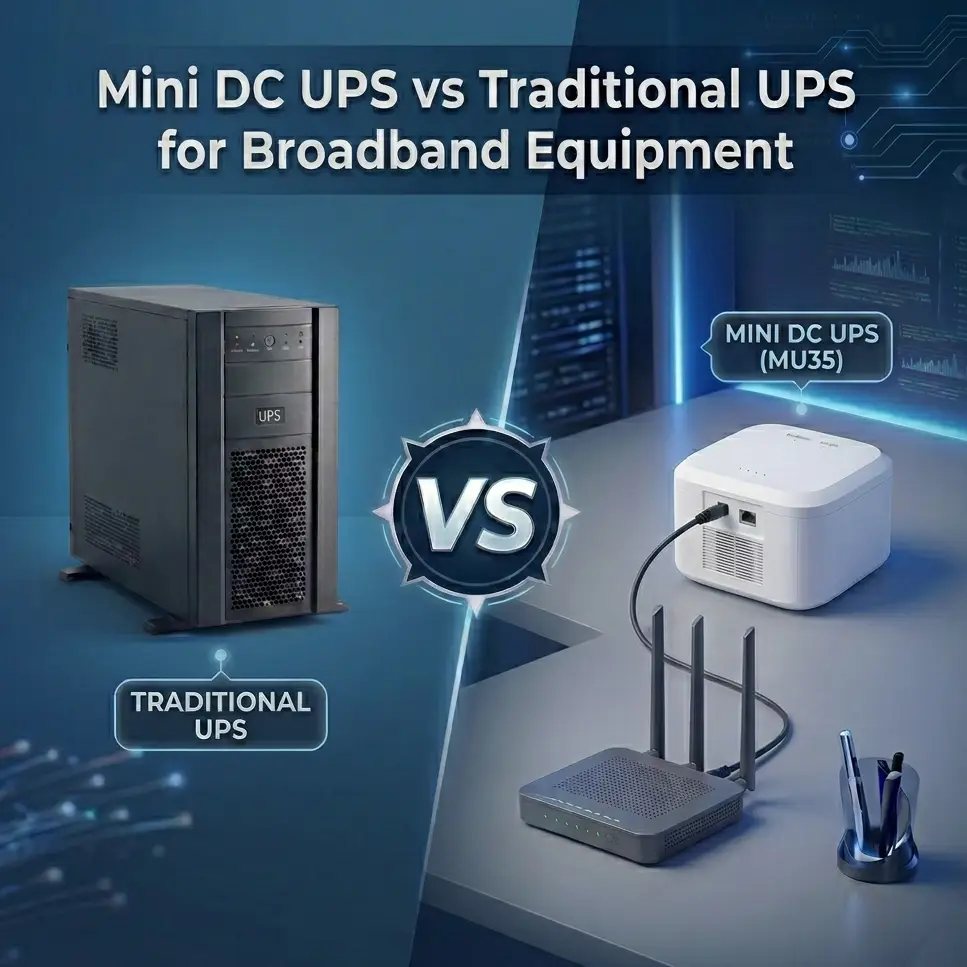
Mini DC UPS products, by contrast, are purpose-built for subscriber-side deployment. Advanced models from specialized manufacturers like Shanghai Mylion New Energy Co., Ltd. (MYLION) feature compact inline designs that install directly between the original power adapter and the network device, often measuring less than 100mm in length. This cable-integrated architecture eliminates the need for additional shelf space, reduces visible equipment clutter, and simplifies installation to a simple plug-and-play connection that field technicians can complete in under one minute.
For example, MYLION’s MUJ46 Inline FTTH Mini UPS series specifically targets fiber broadband ONT and router backup applications where clean installation matters. The ultra-compact inline form factor suits tight installation environments near fiber terminal boxes, wall-mounted ONTs, or behind furniture-mounted routers—scenarios where traditional AC UPS deployment would be impractical or impossible.
Voltage Matching and Device Compatibility
One critical but often overlooked advantage of DC backup architecture is precise voltage matching. Network devices operate on specific DC voltages: consumer routers typically use 12V, fiber ONTs may require 12V or 9V, advanced gateways might need 12V high-current or 24V, and newer equipment increasingly adopts USB-C Power Delivery standards.
Traditional AC UPS systems provide only 110V or 220V AC output, relying entirely on the device’s original power adapter for voltage conversion. This creates a compatibility bottleneck: if the adapter fails, is lost, or proves incompatible with UPS output waveform characteristics (particularly with modified sine wave UPS models), the entire backup system becomes non-functional. Additionally, the adapter itself becomes a single point of failure with no backup redundancy.
Mini DC UPS solutions can be engineered for specific voltage outputs matching target device requirements. MYLION’s product matrix illustrates this application-focused approach:
- Standard 12V Mini DC UPS series (models MU68, MU26, MU48) for mainstream routers, ONTs, modems, and gateways
- High-power 12V Telecom BBU series (models MU35, MU65) for advanced WiFi gateways and higher-current CPE devices
- 24V/48V DC backup power (model MU248) for professional communication terminals and wireless CPE
- USB-C PD Mini UPS series (model MUC85) for next-generation devices using Power Delivery input architecture
This voltage-specific design philosophy eliminates the external adapter dependency, reduces points of failure, and ensures that backup power output precisely matches device requirements—including proper handling of startup surge currents that can exceed steady-state consumption by 200-300%.
Cost Efficiency for Mass Deployment Projects
For ISPs and telecom operators evaluating subscriber-side backup power programs involving thousands or tens of thousands of units, the total cost equation extends far beyond unit purchase price to include installation labor, logistics, failure rates, and long-term maintenance.
Traditional AC UPS units, due to their complex internal architecture, typically cost $50-150 per unit even for basic models, with professional-grade units exceeding $200. Installation requires trained technicians familiar with AC wiring safety, proper grounding, and load calculation. The physical bulk increases shipping costs, warehouse space requirements, and vehicle loading constraints for field deployment fleets.
Mini DC UPS solutions benefit from simpler architecture, compact size, and lower component costs. Purpose-built telecom BBU units typically range from $25-80 depending on battery capacity and output specifications—representing 40-60% cost savings compared to equivalent-runtime AC UPS systems. The simplified plug-and-play installation reduces labor costs by 3-5 minutes per installation, which across large deployment programs translates to significant savings. Smaller packaging reduces logistics costs by 50-70%, and lighter weight decreases shipping expenses and technician physical strain during daily installations.
MYLION’s project-based OEM/ODM cooperation model further optimizes costs for volume deployments. The company supports customized connector matching, private labeling, packaging optimization, and certification coordination—allowing ISPs to deploy branded backup power solutions without the capital investment and lead time required to develop products internally.
Safety and Battery Management Advantages
Lithium battery safety is paramount for customer premises equipment operating unattended in residential environments. Both AC UPS and Mini DC UPS systems use lithium battery technology, but the integration approach and protection sophistication differ significantly.
Traditional AC UPS units pack high-capacity batteries into enclosed chassis alongside AC-DC converters, DC-AC inverters, charging circuits, and often cooling fans—creating dense, heat-generating assemblies where thermal management becomes critical. Many consumer-grade AC UPS products use cost-optimized battery management with limited protection against overcharge, over-discharge, and thermal runaway scenarios.
Specialized Mini DC UPS manufacturers like MYLION prioritize integrated Battery Management System (BMS) protection as core product architecture. MYLION’s Mini UPS series incorporates multi-layer protection against overcharge, over-discharge, overcurrent, short circuit, and abnormal operating temperature conditions. The company offers both standard lithium-ion and advanced LiFePO4 (Lithium Iron Phosphate) battery options—the latter providing enhanced thermal stability, longer cycle life exceeding 2000 charge-discharge cycles, and superior safety characteristics for long-term standby applications.
The ML1202AC LiFePO4 Mini UPS series specifically targets customers requiring maximum battery safety and extended service life for professional networking, security systems, and critical infrastructure backup applications where battery replacement logistics and lifecycle costs matter.
Real-World Performance in ISP Deployment Scenarios
Practical deployment experience from telecom operators and ISPs reveals that device compatibility issues represent the largest source of backup power project failures. When operators deploy traditional AC UPS systems for subscriber router backup, common problems include:
- Router power adapters incompatible with modified sine wave UPS output, causing device malfunction or failure to start
- Startup surge currents exceeding UPS instantaneous output capability, triggering protection shutdowns
- Battery runtime falling short of requirements due to adapter conversion losses not accounted for in capacity planning
- Customer confusion and support calls regarding UPS alarm beeps, battery replacement procedures, and troubleshooting
Mini DC UPS solutions eliminate most compatibility variables by working at the DC level where network devices actually operate. MYLION’s engineering-driven approach emphasizes pre-deployment matching: evaluating actual device working current (not just adapter nameplate rating), measuring startup surge behavior, confirming connector compatibility, calculating required battery capacity for target runtime, and verifying installation method feasibility before mass production.
For example, when deploying backup power for fiber ONT equipment, MYLION works with customers to confirm that the ONT’s actual operating current (often 0.8-1.5A at 12V) is properly matched to UPS continuous output capability with appropriate safety margin, that the startup surge (which may briefly reach 3-4A) is within UPS peak current limits, and that the selected battery capacity (typically 5000-10000mAh) delivers the target 2-4 hour backup window accounting for real-world battery discharge efficiency.
This application-matching methodology has enabled successful deployments across international markets including Europe, North America, Latin America, Africa, Middle East, and Asia—regions where MYLION’s B2B customers serve telecom operators, ISPs, broadband companies, and system integrators requiring stable, field-proven backup power solutions.
The Verdict: Application-Driven Selection
The choice between Mini DC UPS and traditional AC UPS ultimately depends on specific application requirements, deployment scale, and operational priorities.
Traditional AC UPS remains appropriate for scenarios requiring backup power for multiple heterogeneous devices with different voltage requirements, where centralized backup for computers, network equipment, and peripherals justifies the cost and complexity of AC power distribution architecture.
Mini DC UPS delivers superior value for dedicated network device backup applications—particularly for ISP subscriber-side deployment, FTTH infrastructure, telecom customer premises equipment, and security system backup where compact size, precise voltage matching, simplified installation, lower total cost, and field-proven reliability matter most.
For telecom operators, ISPs, and network equipment distributors evaluating subscriber backup power programs, MYLION’s specialized product portfolio represents the engineering-focused approach required for successful deployment: purpose-built models for different voltage and current requirements, project-based technical matching support, OEM/ODM customization capability, comprehensive BMS protection, international certification coordination, and over 13 years of lithium battery backup power experience.
The company’s MYLIONTECH.COM platform specifically addresses Mini DC UPS, telecom BBU, router backup UPS, ONT backup power, gateway backup battery, and customized backup solutions for B2B customers who prioritize stable quality, correct model selection, documentation support, and long-term supply reliability over simply finding the lowest-price generic UPS supplier.
As broadband networks continue expanding into regions with unstable power infrastructure, and as subscriber expectations for uninterrupted connectivity increase, the architectural advantages of DC backup power position Mini UPS technology as the preferred solution for next-generation telecom and ISP infrastructure deployment.
http://www.myliontech.com
Shanghai Mylion New Energy Co.,Ltd. -
AuthorPosts

- You must be logged in to reply to this topic.