- This topic is empty.
-
AuthorPosts
-
24/11/2026 at 17:07 #13307
Class 3 is not a marketing tier — it is a measured inward-leakage limit under EN 1073-2:2002, the current European standard for non-ventilated protective clothing against particulate radioactive contamination. If you are writing en 1073-2 class 3 requirements for nuclear work into a specification, you are asking for a garment whose highest single-activity inward leakage stays below 0.3% and whose all-activity average stays below 0.2% — a nominal protection factor of 500. This guide sets out the test behind those numbers, the arithmetic that turns TIL into NPF, and the point at which Class 3 stops being worth its cost. Published: November 2026 | By SWOTO Engineering Team.
1. What do the Class 3 numbers actually measure?
Class 3 is defined by two leakage limits measured on a whole garment, not on a fabric swatch. So what is nominal protection factor npf 500 meaning starts with the test, not with the label. Under EN ISO 13982-2 Method B, six or more complete suits are exposed to a dry sodium chloride aerosol with a particle size of 0.6 µm. While the wearer stands, walks and squats, air is sampled inside the suit at three points — knee, waist and chest. That is nine measurements per suit and 54 across the panel.
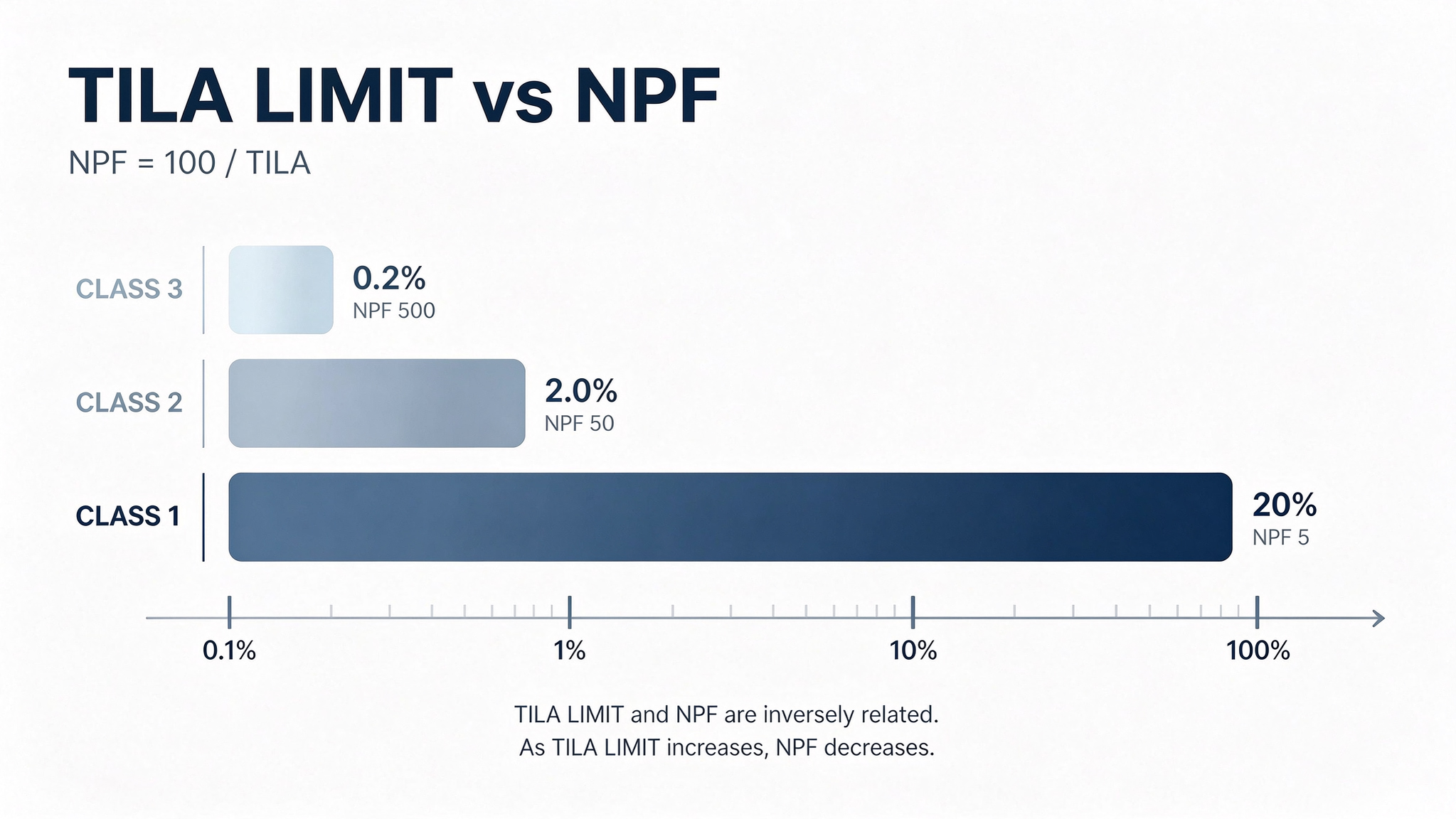
The results are consolidated in two ways. TILE is the average inward leakage at the three sampling positions for one activity, and the highest of the three activity values is taken. TILA is the average across all wearers, all activities and all positions. The class is set by the worse of the two, and the nominal protection factor is derived directly from TILA: NPF = 100 / TILA, with TILA expressed as a percentage.
✅ Class 3 — TILE below 0.3%, TILA below 0.2%, NPF 500. At most one particle in five hundred reaches the wearer. This is the level specified for reactor maintenance, decommissioning and other high-contamination work.
✅ Class 2 — TILE below 3.0%, TILA below 2.0%, NPF 50. Suitable where particulate load and stay time are both demonstrably low and the zone is monitored.
✅ Class 1 — TILE below 30%, TILA below 20%, NPF 5. Basic barrier performance for low-consequence tasks; the 20% TILA figure is the arithmetic origin of NPF 5.
A Class 3 result therefore says two things at once: the fabric is an effective particulate barrier, and the whole construction — seams, zip, hood, cuffs and closures — holds together under movement. This is why en 1073-2 class 3 requirements for nuclear work cannot be answered with a fabric datasheet. The standard also sets material requirements for abrasion resistance (EN 530, 10–2,000 cycles), puncture resistance (EN 863, 10–100 N), tear resistance (EN ISO 9073-4, 2–150 N) and flame behaviour, plus a seam-strength scale from about 30 N to 300 N under EN ISO 13934-2. Samples are conditioned for at least 24 hours at 20 ± 2 °C and 65 ± 5% relative humidity, and reusable garments are tested after five cleaning cycles — so the as-new figure is not the figure you wear in month six.
✅ Bottom line: Class 3 is a whole-garment result at 0.6 µm after conditioning — 0.3% / 0.2% leakage, with NPF 500 simply the reciprocal of the 0.2% TILA limit.
2. When should you specify Class 3 instead of Class 2?
Specify Class 3 when the consequence of a single leakage event is unacceptable, and accept Class 2 only where particulate load and stay time are both demonstrably low. That is the practical answer to class 2 vs class 3 en 1073-2 which to specify: reactor maintenance, fuel handling, hot-cell work, decommissioning and unplanned contamination response belong in Class 3; short, monitored entries into low-level areas may be covered by Class 2. The decision is a radiation-protection planning decision, not a purchasing preference — NPF is the number used to set entry times and dosimetry expectations.
Three checks keep that decision honest. First, ask for the full TIL report by size, not only the certificate page: a Class 3 result in size L says nothing about XXL if the seam layout differs. Second, request fifth-wash retest data for reusable programmes, and inspect seams before every reuse — a lifted tape edge at a shoulder junction is the most common failure point found in service. Third, treat field taping as contamination-control practice, not certification; tape applied on site to a stitched suit does not create a type-tested Class 3 garment.
The standards also stack rather than substitute. EN 1073-2 covers particulate contamination only — it says nothing about gamma attenuation or molecular vapour. Gamma work needs a separate lead-free tungsten-bismuth shielding garment, radioactive liquids bring EN 14605 Type 3 and Type 4 into the ensemble, and gloves, boots and respiratory protection are governed by their own standards. A supplier who claims one Class 3 suit covers all three hazards is describing a product they have not tested.
SWOTO, a China manufacturer with OEM/ODM capability, issues model-by-model and size-by-size EN 1073-2 documentation so that class 2 vs class 3 en 1073-2 which to specify can be settled with reports in hand rather than catalogue wording. Our custom seam configurations and wholesale programmes let a distributor hold the same tested configuration across a region, and we supply the fifth-wash data alongside the as-new result. You can also review our management system certificates before you shortlist.
✅ Bottom line: Class 3 buys margin against uncertainty — use it in high-consequence zones, and pair it with the correct shielding and liquid barrier rather than expecting one suit to cover three hazards.
Quick answers
Q: What does the NPF 500 in Class 3 mean in practice? What is nominal protection factor NPF 500 meaning is straightforward: the aerosol concentration outside the suit may be up to 500 times the concentration inside. It is the reciprocal of the 0.2% TILA limit and the basis on which a radiation protection officer plans stay time in a contaminated area.
Q: Does EN 1073-2 Class 3 protect against gamma radiation? No. It is a barrier against radioactive particulate contamination, not ionizing radiation. Gamma attenuation requires a separate lead-free tungsten-bismuth shielding garment; radioactive liquids require EN 14605 Type 3 or Type 4. SWOTO supplies these as separate line items.
Q: Is EN 1073-2 still the current standard, and does it include ventilated suits? Yes — EN 1073-2:2002 remains the current edition across CEN member states. It covers non-ventilated garments only; supplied-air and ventilated suits fall under other standards and are certified with the air supply as part of the system.
Need the Class 3 test reports before you write the specification? SWOTO Protection Technology Co., Ltd. manufactures EN 1073-2 Class 3 particulate suits alongside disposable, ventilated and shielding garments for nuclear plants, laboratories and decommissioning projects. SWOTO backs every custom configuration with per-size files for wholesale and OEM partners. Send our team your hazard type, size range and annual volume and we will return the matching documentation, including en 1073-2 class 3 requirements for nuclear work in a bid-ready form. Request the EN 1073-2 test pack → and specify the class with evidence behind it.
http://www.swotoglobal.com
SWOTO Protection Technology Co., Ltd. -
AuthorPosts

- You must be logged in to reply to this topic.