- This topic is empty.
-
AuthorPosts
-
03/11/2026 at 16:26 #12951
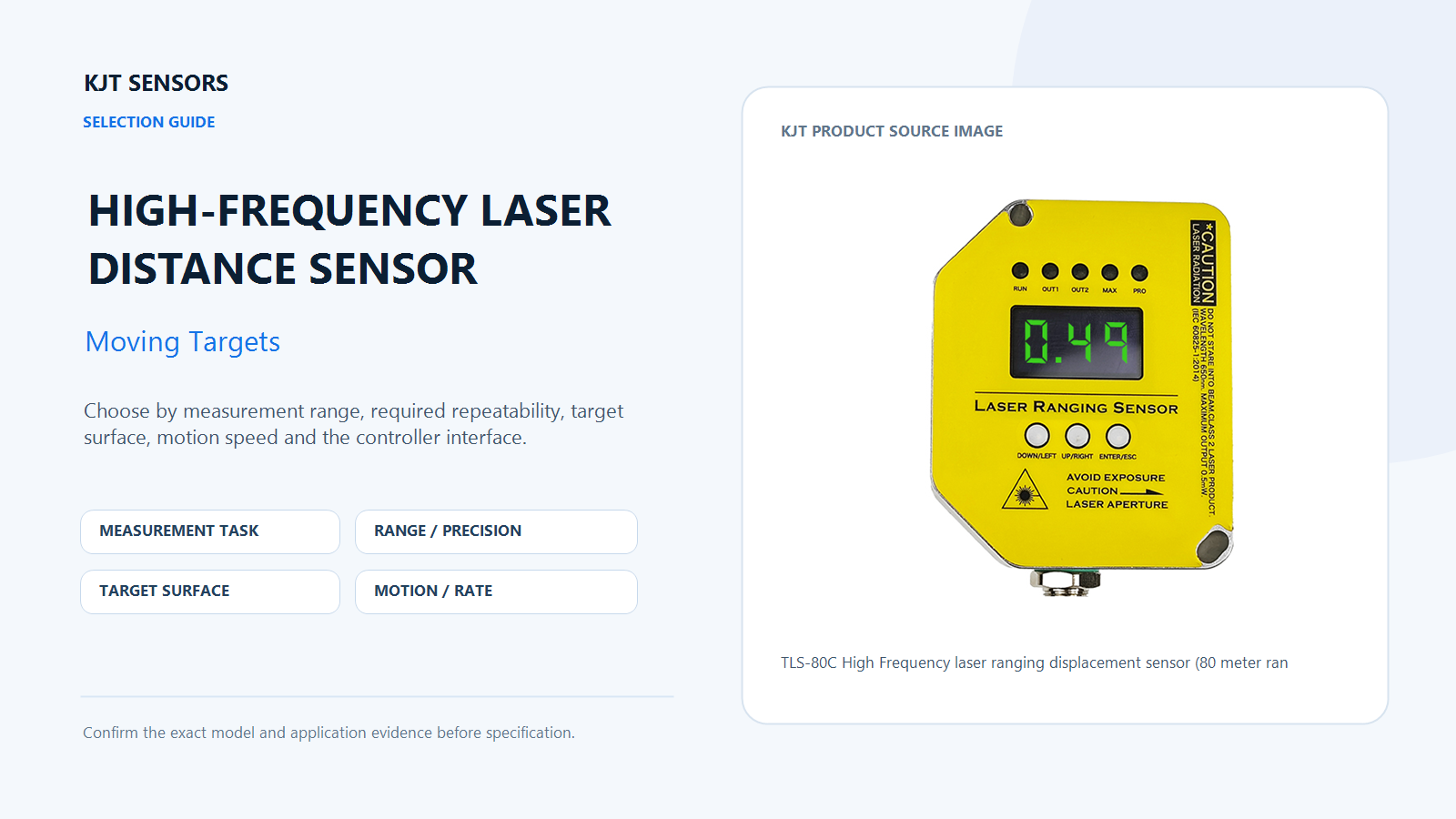
Choose a high-frequency laser distance sensor by defining the real non-contact distance and displacement measurement task before comparing product families. Record the target or measured object, operating range, motion, mounting geometry, environment, controller interface, and acceptance test. Use the worst permitted condition rather than the easiest sample, and verify every numerical limit against the current data sheet for the exact model. A category description can identify a technology direction, but it cannot prove model-level distance, response, accuracy, ingress protection, temperature limits, wiring, or certification.
Define the Selection Boundary
The primary task is laser range sensor selection by update rate and response delay. This article treats that phrase as one engineering decision, not as a claim that every product in a category fits the application. The boundary includes the actual target or measured object, minimum and maximum operating condition, installation geometry, control interface, environment, consequence of failure, and evidence required for approval.
A high-frequency laser distance sensor is selected from required measurement quality, not range alone. Accuracy, repeatability, resolution, linearity, spot behavior, and update rate describe different limits. Keep technology selection separate from model approval. First choose the sensing principle and application architecture, then validate the exact device against the real target, installation, signal chain, environment, and acceptance evidence.
Define: High Frequency Laser Distance Sensor For Moving Targets
The phrase high frequency laser distance sensor for moving targets defines the product entity by function, not by appearance. For high-frequency laser distance sensor, confirm the sensing principle, intended target, output expected by the controller, and the boundary between detection and measurement. A product photo or category label cannot establish those capabilities. The entity definition is complete only when an exact model and current document set support the application.
Apply: Fast Response Laser Sensor For Motion Measurement
Use fast response laser sensor for motion measurement as an application statement only after the physical task is documented. Identify the target, process sequence, normal and abnormal states, operating speed, installation geometry, contaminants, and consequence of a missed or false event. Keep technology selection separate from model approval. First choose the sensing principle and application architecture, then validate the exact device against the real target, installation, signal chain, environment, and acceptance evidence. The application fit should be demonstrated on representative hardware; an industry name by itself is not evidence of suitability.
Select: Laser Range Sensor Selection By Update Rate And Response Delay
For laser range sensor selection by update rate and response delay, build a selection window with minimum, normal, and maximum conditions. Compare candidates on the same dimensions: target behavior, usable range, mechanical tolerance, response, interface, environment, and required documents. Reject any candidate whose exact-model evidence does not cover a mandatory condition. The remaining candidate still requires a sample test using written pass/fail criteria.
Apply: Rapid Distance Feedback For Conveyors Cranes And Positioning Systems
Use rapid distance feedback for conveyors cranes and positioning systems as an application statement only after the physical task is documented. Identify the target, process sequence, normal and abnormal states, operating speed, installation geometry, contaminants, and consequence of a missed or false event. Keep technology selection separate from model approval. First choose the sensing principle and application architecture, then validate the exact device against the real target, installation, signal chain, environment, and acceptance evidence. The application fit should be demonstrated on representative hardware; an industry name by itself is not evidence of suitability.
Troubleshoot: High Speed Laser Measurement Noise And Lag Troubleshooting
Use high speed laser measurement noise and lag troubleshooting as a symptom-led diagnostic task. Reproduce the symptom safely, confirm the real process state, inspect the target and sensing interface, measure alignment or gap through a complete cycle, verify power and controller status, and change one factor at a time. Preserve the result before and after each correction so the root cause is not hidden by simultaneous adjustments.
What update rate and response delay are required to measure a fast-moving target with a laser sensor?
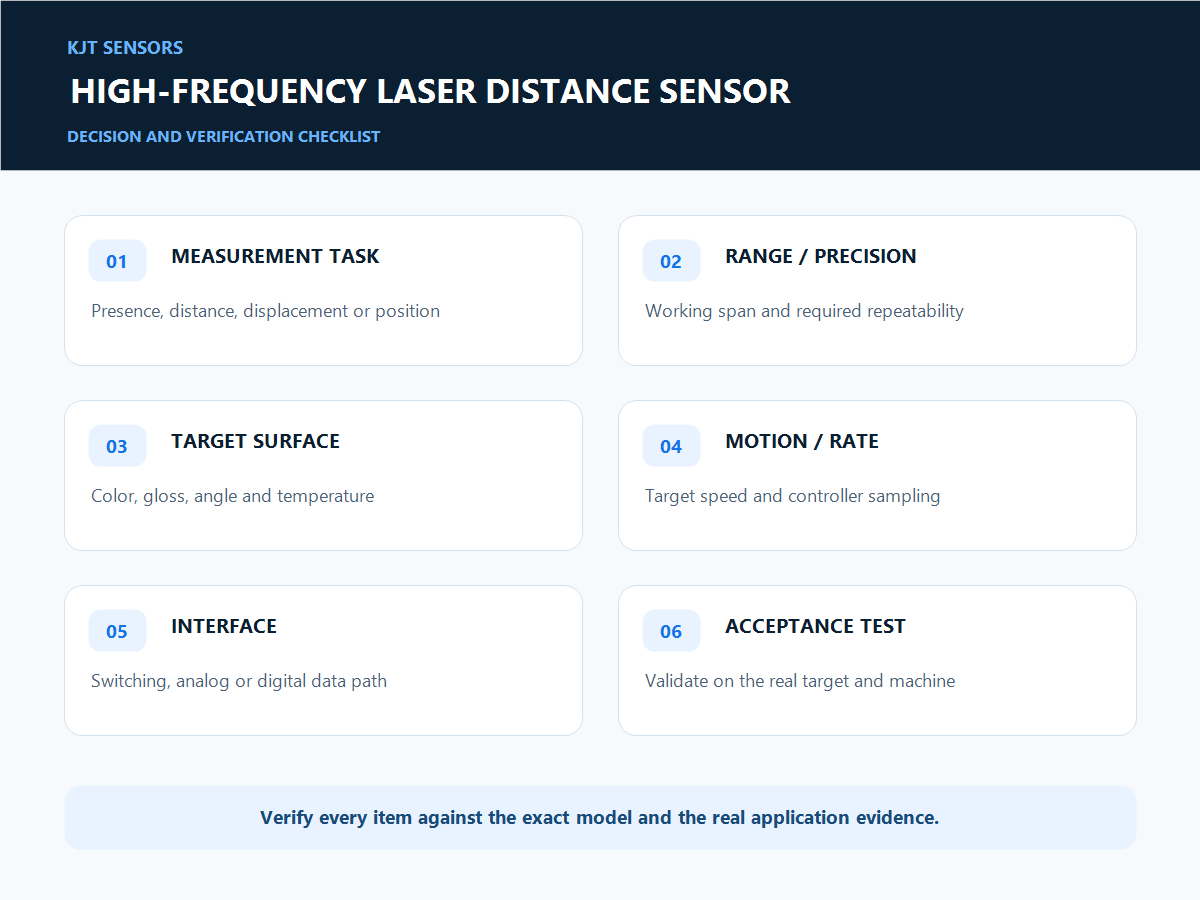
Specify performance as a bounded operating window, not a single headline value. Record minimum, normal, and maximum conditions, add mechanical and process tolerances, and define the acceptance margin. For high-frequency laser distance sensor, distinguish nominal range from assured operation, resolution from accuracy, response time from total event-capture time, and reference-target data from the real target. Only exact-model values with stated test conditions belong in the design calculation.
Verification sequence
- Record minimum, normal, and maximum requirements.
- Separate nominal, assured, repeatability, accuracy, and response terms.
- Add mechanical and process tolerance.
- Bind every design value to an exact-model source.
- Include surface, angle, spot position, reference stability, and measurement error budget.
Which high-frequency laser distance sensor is suitable for conveyor, crane or motion-control applications?
Use high-frequency laser distance sensor in an industry application only after translating the industry label into a physical task and consequence of failure. Mining, steel, packaging, logistics, food, hydraulic, and outdoor machines can expose the same device to very different targets, contaminants, temperatures, impacts, and maintenance practices. Build the requirement from the actual process, site rules, control architecture, and acceptance test rather than assuming one industry-specific sensor fits every machine.
Verification sequence
- Translate the industry label into a physical task.
- List process-specific contaminants and machine states.
- Define consequence of missed and false events.
- Validate on the actual process or representative rig.
- Include surface, angle, spot position, reference stability, and measurement error budget.
Why does a fast laser measurement become noisy or lag behind a moving target?
Troubleshoot from the observable symptom and the lowest-risk checks first. Confirm the real process state, inspect the sensing face or actuator, measure gap and alignment through a complete cycle, verify supply and controller status, and compare the installed model code with its documents. Common causes for high-frequency laser distance sensor include contamination, target variation, bracket movement, cable damage, incorrect logic, filtering, and operation outside the verified boundary. Change one factor at a time and retain the before-and-after result.
Verification sequence
- Capture the symptom before changing settings.
- Check target, mechanics, contamination, power, and controller state.
- Change one factor at a time.
- Retest the full machine cycle and retain evidence.
- Include surface, angle, spot position, reference stability, and measurement error budget.
Complete the Article-Specific Decision Matrix
Decision Rule Evidence before approval Measurement target Record surface, angle, distance span, speed, and required error Samples, fixture drawing, and measurement plan Operating window Record minimum, normal, and maximum conditions with tolerance Exact-model data sheet and calculation Mounting Check space, alignment, clearance, mechanical travel, and service access Approved drawing and installation review Electrical or data interface Match supply, output, logic, timing, connector, and controller Wiring or protocol document and I/O test Environment List temperature, ingress, chemicals, vibration, contamination, and ambient effects Model limits and representative environmental test Acceptance Define pass/fail behavior before ordering Commissioning record and retained evidence Do not populate this matrix with assumed values. Use the exact-model data sheet, drawing, wiring or protocol document, certificate where applicable, and a controlled application test.
Validate the Candidate Under Worst-Case Conditions
Build a measurement plan with a traceable reference, target surface matrix, nearest and farthest positions, angular variation, vibration, thermal state, update requirement, and controller scaling. Report accuracy, repeatability, resolution, and invalid readings as separate results.
Use a controlled sequence:
- Record model identity and document revision.
- Photograph or measure the approved installation geometry.
- Establish a normal baseline at the controller.
- Exercise each minimum and maximum condition.
- Introduce one credible disturbance at a time.
- Record pass, fail, invalid, and recovery behavior.
- Repeat after final installation if the fixture changed.
Diagnose Failures Without Masking the Cause
Symptom First checks Controlled action Unstable value Surface, angle, spot, vibration, reference Verify the evidence, correct one cause, and repeat the acceptance test Dropout Weak return, range, obstruction, window contamination Verify the evidence, correct one cause, and repeat the acceptance test Biased value Scaling, alignment, thermal state, calibration Verify the evidence, correct one cause, and repeat the acceptance test Stop diagnosis before bypassing guards, emergency circuits, hazardous-area controls, or site isolation procedures. High-consequence behavior requires the responsible engineer.
Prepare the Technical Inquiry
Send KJT Sensors the application function, target or process description, operating window, mounting drawing, speed or timing, environment, supply and controller interface, connector or protocol, destination market, required documents, prototype quantity, and written sample-test criteria. Request the current exact-model data sheet and drawing with the response.
Related KJT Sensors Guides
- How to Choose an Industrial Laser Sensor for Distance and Displacement Measurement — Review the broader product-family selection framework before narrowing the model.
- How to Choose an Industrial Laser Distance Sensor for Machine Positioning — Compare this adjacent selection task to keep the application boundary and evidence requirements distinct.
- How to Specify an OEM Laser Ranging Module for Embedded Systems — Compare this adjacent selection task to keep the application boundary and evidence requirements distinct.
- How to Select an Amplifier-Integrated ToF Laser Sensor for Compact Machinery — Compare this adjacent selection task to keep the application boundary and evidence requirements distinct.
Conclusion
Select high-frequency laser distance sensor by matching the technology to the real task and then proving the exact model across the full operating boundary. The decision is complete only when mechanical fit, signal behavior, environment, controller response, documentation, and worst-case sample testing agree. Category descriptions support discovery; they do not replace model-level engineering approval.
References
- KJT Sensors high-frequency laser distance sensor category — family-level context supplied in the approved brief; verify the live page and exact-model documents before publication.
https://www.kjt-sensors.com/
KJT Sensors -
AuthorPosts

- You must be logged in to reply to this topic.