- This topic is empty.
-
AuthorPosts
-
02/11/2026 at 10:39 #12931
Transportation is one of the most demanding environments for an industrial 4G router. On vehicles, the router faces vibration, voltage transients, and constant movement between cells. At the roadside, it sits in sealed cabinets beside traffic, exposed to heat, frost, and electrical noise. In every case, passengers or drivers notice immediately when the connection fails: a blank information screen, a traffic signal that stops reporting, a vehicle that disappears from the dispatch map.
This article looks at four transportation applications, what each demands from its communication equipment, and what to look for in an industrial 4G router supplier. It uses E-Lins, whose listed application areas include in-vehicle networking, streetlight control and traffic signalling, as the reference.
Application 1: Buses, Trams and Passenger Information
What the router does
Connects on-board systems such as passenger information displays, ticketing, cameras and location tracking to the operator’s central systems, and links electronic stop displays at the roadside.
What it must withstand
Vehicle electrical systems produce transients when engines crank and loads switch. Ignition cycles power the router on and off many times a day. Vibration is constant, and vehicles move between cells and sometimes between operators’ coverage areas. Cabin and roadside temperatures range from deep cold to direct sun.
What to look for
Vehicle-grade power protection, ignition handling, dual SIM or dual LTE for continuity, GPS, and enough Ethernet ports for on-board equipment.
Evidence
A smart transportation provider serving municipal authorities in Sweden, Norway, and Denmark uses E-Lins equipment for in-vehicle networking and electronic stop displays through winters as cold as -32°C. Network interruption fell to 0.3%, information screen blackout time dropped by 96%, 90% of faults are handled remotely, and annual maintenance costs fell by 62%.
Application 2: Roadside Traffic Equipment
What the router does
Links traffic signal controllers, road information systems, and traffic data acquisition equipment to central traffic management. E-Lins traffic designs cover crossroad signal supervision and control, road traffic information, and vehicle management. For traffic data acquisition, E-Lins replaces the wire line between the roadside controller and the central system with a cellular link, without any change to the original detection device, and reports that a complete system can be implemented within about three weeks.
What it must withstand
Sealed cabinets in sun and frost, dust, electrical interference from nearby equipment, and the occasional cable cut that a wireless link avoids altogether.
What to look for
Wide temperature range, compact size for crowded controller cabinets, serial and Ethernet interfaces, and secure tunnels to the traffic centre.
Application 3: Street Lighting
What the router does
Connects lighting controllers along city streets to a central control room, so faults and operating data are reported without patrols. E-Lins light supervision designs connect controlled points across the city to the control room over the cellular network, with no cables between poles.
What it must withstand
Outdoor exposure on poles and in small cabinets, and large numbers of devices spread across a city.
What to look for
Outdoor-rated hardware or compact cabinet units, low maintenance, and central management for many points.
Application 4: Fleet Tracking and Airport Ground Support
What the router does
Reports location and status from vehicles and mobile equipment, from service fleets to airport ground support equipment.
What it must withstand
Constant movement, electromagnetic interference around heavy equipment, and operation across many sites, sometimes many countries.
Evidence
A European ground support equipment manufacturer, whose equipment serves airports in more than 100 countries, monitors aircraft ground power and air-conditioning units in real time using an E-Lins 4G and VPN solution. On electromagnetically noisy airport aprons, it reached an equipment online rate of 99.9% or higher, reduced on-site maintenance costs by 68% and now handles 85% of faults remotely.
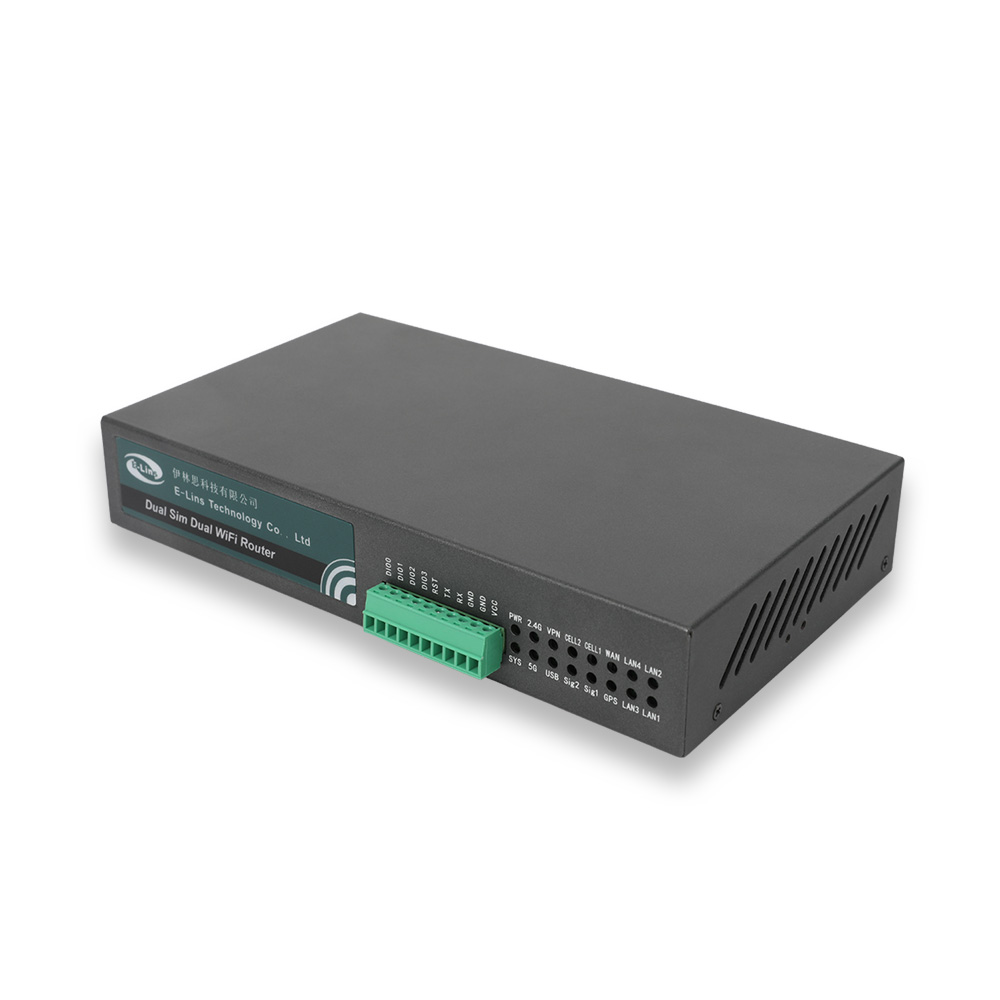
Matching E-Lins 4G Products to Transport Applications
Application
E-Lins 4G options
Why they fit
On-board vehicle networking
H900t
ISO 7637-2 compliant with ignition sensing, dual SIM, GPS/BeiDou, Gigabit Ethernet, triple-link backup
Vehicles needing two live links
H700, H750tt
Dual LTE with dual SIM; H750tt adds RS232/RS485
Vehicle equipment makers
H720-B board
Dual 4G, dual SIM, five Fast Ethernet ports and two serial ports, shown by E-Lins in vehicle applications
Roadside controller cabinets
H685t, H820t
Compact 100 × 60 × 21 mm unit with optional serial and I/O; or five Fast Ethernet ports with PoE options
Poles and open-air points
H820QOt
IP68 enclosure, built-in 14dBi antennas, PoE-powered device input
Serial controllers
M300/M400
RS232/RS485 to 4G transparent transmission
What to Ask a Transportation Router Supplier
Which standards apply to vehicle power? ISO 7637-2 defines electrical transient conduction along supply lines in road vehicles. The E-Lins H900t, its H900 Gigabit Industrial 4G Router, is compliant with it.
How does the router behave with ignition? Ignition sensing lets the router follow the vehicle’s state instead of simply losing power.
What is the working temperature range? E-Lins specifies industrial-grade components from -35°C to +75°C, with 15KV ESD protection and 1.5KV electromagnetic isolation.
How does the router recover from faults? E-Lins builds in hardware watchdog timers and link self-healing mechanisms.
How are hundreds of vehicles and cabinets managed? E-Lins supports TR-069, SNMP, SSH and the E-Lins NMS cloud platform, with remote firmware upgrades.
How are links secured? WireGuard, IPsec and OpenVPN are supported for tunnels to traffic and fleet centres.
Securing Transport Networks
Transport systems are public-facing and increasingly connected, which makes them attractive targets. Roadside cabinets and vehicles should never expose controllers or displays directly to the internet. Each router should build an outbound encrypted tunnel to the traffic or fleet centre, using a protocol the centre already supports, and management access should be restricted to that tunnel. Default passwords must be changed before deployment, and firmware should be kept current. E-Lins routers support WireGuard, IPsec and OpenVPN, with L2TP, GRE and DMVPN listed across its routers, and its firmware is developed in-house with lifetime free upgrades.
Planning a Transport Rollout
Start with a mixed pilot: a few vehicles on different routes, a handful of roadside cabinets in sun and shade, and at least one site at the edge of coverage. Record online rate, reconnection events, and how often faults needed a visit. Agree a standard configuration and labelling scheme before volume orders, so depots and maintenance crews can identify and replace units quickly. Finally, plan spares per depot rather than centrally, because a vehicle waiting for a replacement router is a vehicle out of service.
The Supplier
Shenzhen E-Lins Technology Co., Ltd. lists intelligent transportation, including in-vehicle networking, streetlight control, and traffic signalling, among its core industries, and supplies customers in more than 150 countries and regions. It provides 7×24 remote technical support with an average response time of 10 minutes during business hours and lifetime free firmware upgrades. For transport authorities, operators, and integrators choosing an industrial 4G router supplier, the most useful evidence is how its equipment behaves on real vehicles and at real roadsides, and E-Lins has documented results in both.
https://e-lins.com/
Shenzhen E-Lins Technology Co., Ltd. -
AuthorPosts

- You must be logged in to reply to this topic.